WhatsApp/WeChat:(+86)13719017091
Email:GarmentLinks@outlook.com

Garment Accessories Compliance: Avoid Export Recall Risks
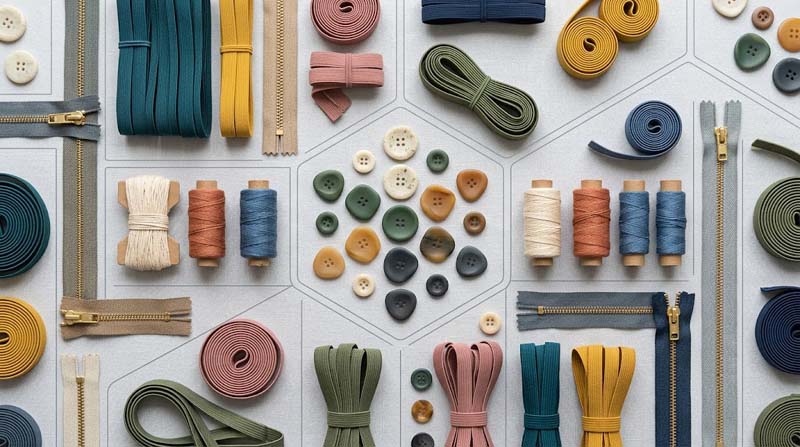
Why Tiny Garment Accessories Lead to Million-Dollar Recall Crises?
In the international textile trade, many companies focus their attention heavily on large areas of woven fabrics while completely neglecting threads, tapes, buttons, zippers, and various labels—collectively known as garment accessories. However, it is precisely these seemingly insignificant components that are becoming the “hardest-hit areas” for overseas customs seizures and returns.
In recent years, Chinese textiles exported to developed markets such as the European Union, the United States, and Japan have frequently encountered rejections. A deep analysis of these cases reveals that the core trigger is not the fabric itself, but rather the excessive harmful substances or structural design violations found in the accessories. For instance, a garment factory had an entire batch of children’s knitted dresses exported to Japan rejected because the elastic bands used at the waist exceeded formaldehyde limits. Another enterprise faced a full-batch return of children’s clothing exported to the EU simply because the decorative drawstrings exceeded the safety length limit. For businesses, this kind of oversight, where they “lose the tongue for the sake of the teeth,” always comes with catastrophic financial and brand reputation losses.
Compliance Requirements for Garment Accessories in Major Global Markets
Stringent Market Access Standards in the EU, US, and Japan
Developed countries and regions have constructed extremely high safety and hygiene barriers for textiles entering their local markets. Reputable international brands routinely mandate comprehensive safety testing for all fabrics and garment accessories before mass production. This proactive supply chain audit effectively mitigates risks in advance, ensuring that products fully align with international environmental regulations.
Core Regulations of China’s Mandatory Standard GB18401
Beyond overseas markets, China’s mandatory standard GB18401 (National General Safety Technical Code for Textile Products) applies equally strict limits to accessories. Under this standard, the definition of textile products fully encompasses garment trims and accessories. This means accessories, like fabrics, must adhere to the standard criteria for Categories A (Infant Products), B (Products with Direct Skin Contact), or C (Products without Direct Skin Contact) based on their final consumer application.
Guide to Safety Testing Items for Core Garment Accessories
According to the rigorous criteria for eco-textiles, the physical and chemical testing items required for different accessory materials before entering global markets vary fundamentally. As an international seller, you must precisely master the following classified testing requirements:
1. Textile-Based Accessories (Threads, Ribbons, Webbing, etc.)
Because their material attributes match those of the main fabric, their testing indicators perfectly align with the bulk fabric. The core testing items include pH value, formaldehyde content, banned azo dyes, abnormal odors, and various color fastness metrics.
2. Metal-Based Accessories (Buttons, Metal Rings, Zippers, etc.)
Metal components are highly susceptible to introducing toxic heavy metals during manufacturing and electroplating. The focus of testing for these accessories lies in the amount of extractable heavy metals and their standard release rates (such as nickel release), preventing chronic poisoning or allergic reactions from prolonged skin contact.
3. Plastic-Based Accessories (Plastic Buttons, Adjusters, etc.)
Plastic products usually contain complex chemical additives. For plastic accessories, it is mandatory to strictly test for extractable heavy metals, banned azo dyes, total cadmium content, and tributyltin (TBT) among other environmental hormone substances.
4. Mechanical Safety and Special Process Requirements
In addition to chemical and environmental indicators, there are strict physical safety red lines for specific consumer demographics, especially children’s wear. For example, apparel exported to Japan faces extremely rigorous needle detection requirements to prevent broken needle residues; meanwhile, children’s clothes exported to the EU have explicit restrictions on drawstring length to prevent physical injuries such as strangulation.
How Garment Exporters Can Build an Accessory Risk Control System from the Source
Faced with increasingly stringent international green trade barriers, garment import and export enterprises must rapidly enhance their self-inspection and self-control capabilities.
First, companies must elevate supply chain source control to a strategic priority, breaking the traditional mindset of valuing fabrics while undervaluing accessories. While arranging safety testing for fabrics, garment accessories from the same batch must be synchronously included in the core testing checklist. Secondly, export teams need to establish a normalized regulatory tracking mechanism to deeply study the technical regulations of importing countries (such as the EU REACH regulation, US CPSIA, etc.) as well as the internal Restricted Substances Lists (RSL) of major brand clients. Only by strictly controlling the gate of garment accessories can enterprises fundamentally avoid overseas return risks and ensure the safety and compliance of cross-border e-commerce and bulk exports.


